








Intellectual robbery
The criminal element:
Hikmet Toprak, Professor, Vice Department Head
DOKUZ EYLUL UNIVERSITY Cumhuriyet Bulvari, Alsancak, IZMIR, Turkey
http://web.deu.edu.tr/atiksu/ana52/ani4062.html
stealing intellectual property, word by
word, picture by picture from
www.aquanova.cz, without a
reference to the source.
A few examples of many:
|
This website (original) |
|
|
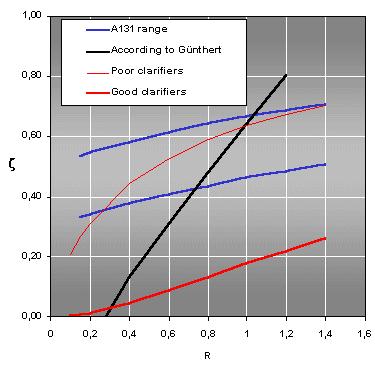
Underflow short-circuiting results from insufficient capacity of sludge transport. Then, instead of withdrawing the sludge bottom concentration, a mixture of the bottom and the inlet concentration is withdrawn. Fraction of the short-circuited flow with the incoming concentration of suspended solids Xa is noted z and called "short-circuiting coefficient" (with values 0 - 1). From mass balance around the sludge outlet point ; (Qr) (Xr) = (z) (Q0) (Xa) + (1 - z) (Qr) (Xb) Equation can be rearranged to ; z = (Xr - Xb) / (Xa - Xb) The advantage of this approach is that z can be calculated from routinely measured concentrations Xr and Xa. The bottom sludge concentration can be easily measured. Early expression of the short-circuiting coefficient comes from Günthert (1984), who expressed both the recycle ratio and the short-circuiting coefficient in percents. If modified to fractions, his equation is ; k = 0.2347 ln (R) + 0.3475 where, by Günthert's definition ; k = Qsc / [ (1 + R) (Q0) ] and Qsc is the short-circuiting flow. The relation between z and k is ; z = (k) (1 + R) = [ 0.2347 ln (R) + 0.3475 ] / (1 + R) Though Günthert claimed that equation located above is valid from R 0.15 to 1.83, the values of Qsc / Q0 are negative below R approx. 0.22 and greater than 1 above R = 1.4. In his field measurements at several plants, the clarifier Buchloe II, which was about average of all, produced typically Xr ~ 6 g / L and Xb ~ 13 g / L. It has to be noted that the bottom concentration would double the recycled concentration at a poorly designed and operated* clarifier only. German guideline A131 recommends to calculate the sludge blanket height from the bottom concentration ; but fails to offer methodology how to calculate the bottom concentration. Instead, it recommends to use Xr ~ 0.7 Xb (or 0.5-0.7), regardless of R. Interpretation in relation to short circuiting is shown in the figure. |
Underflow short-circuiting results from insufficient capacity of sludge transport. Then, instead of withdrawing the sludge bottom concentration, a mixture of the bottom and the inlet concentration is withdrawn. Fraction of the short-circuited flow with the incoming concentration of suspended solids Xa is noted z and called "short-circuiting coefficient" (with values 0 - 1). From mass balance around the sludge outlet point: QrXr = zQ0Xa + (1- z)QrXb Equation can be rearranged to z = (Xr - Xb)/(Xa - Xb) The advantage of this approach is that z can be calculated from routinely measured concentrations Xr and Xa. The bottom sludge concentration can be easily measured. Early expression of the short-circuiting coefficient comes from Günthert (1984), who expressed both the recycle ratio and the short-circuiting coefficient in percents. If modified to fractions, his equation is: k = 0.2347 ln(R) + 0.3475 where, by Günthert's definition: k = Qsc/(1+R)Q0 and Qsc is the short-circuiting flow. The relation between z and k is z = k(1+R) = (0.2347 ln(R)+0.3475)/(1+R) Though Günthert claimed that equation 12 is valid from R 0.15 to 1.83, the values of Qsc/Q0 are negative below R approx. 0.22 and greater than 1 above R = 1.4. In his field measurements at several plants, the clarifier Buchloe II, which was about average of all, produced typically Xr ~ 6 g/l and Xb ~ 13 g/l. It has to be noted that the bottom concentration would double the recycled concentration at a poorly designed clarifier only. German guideline A131 recommends to calculate the sludge blanket height from the bottom concentration but fails to offer methodology how to calculate the bottom concentration. Instead, it recommends to use Xr ~ 0.7Xb (or 0.5-0.7), regardless of R. Interpretation in relation to short circuiting is shown in the figure. |
Differences between AquaNova and Toprak website arise from an earlier version of this website.
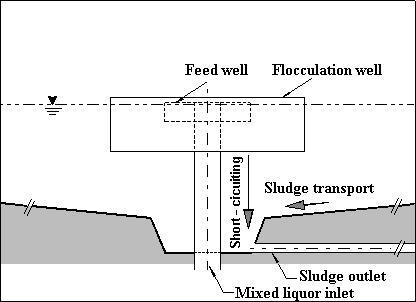
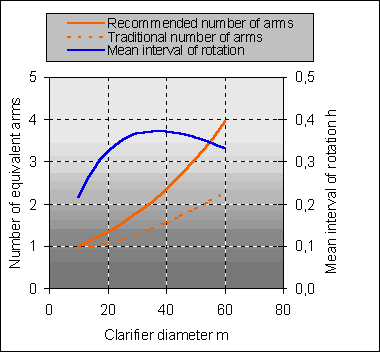
Here are some stolen figures
|
From Toprak (robbery) |
This website (original) |
For Mr. Toprak something to read and learn:
Web of Trust ratings of Toprak´s thievish pages:
Trustworthiness of Toprak´s website

In some cultures it has been acceptable to take another person's work and present it as your own. For instance, many Baroque music masterpieces are built upon musical themes ``borrowed" without explicitly giving credit.
In current Western culture, this is unacceptable, whether it involves music, ideas, or words, and we define the taking of someone's words or ideas as plagiarism. Since ideas and words represent creative effort and have intellectual value, there is a well-defined system of property rights. Stealing words or ideas is theft, just as surely as stealing automobiles, and sanctions can be quite serious.
Thus, if you take a paragraph from someone else's written work and include it in your own work, you must enclose it in quotation marks and give a citation. Even if you change some of the words but leave the writing essentially unchanged, you must put the unchanged pieces in quotation marks and list your source.
If a substantial part of your paper (say, a page or more) consists of a summary of someone else's work using a condensation of their words, or following the same outline as their work, then you must say so: ``This section is taken directly from [...]," or ``This summary closely follows [...]," etc.
You cannot publish a work that is substantially taken from another; you must have ``added some value" by new ideas or new derivations or new implementations and you must clearly distinguish between your work and that of others.
People with a reputation for not giving due credit to other researchers generally find it hard to find collaborators and people who will write letters of recommendation for them.
http://www.jic.ac.uk/corporate/about/policies/good-practice.htm
Piracy is defined as the appropriation of ideas, data, or methods from others without adequate permission or acknowledgment. Again, deceit plays a central role in this form of misconduct. The intent of the perpetrator is the untruthful portrayal of the ideas or methods as his or her own.
Plagiarism is a form of piracy that involves the use of text or other items (figures, images, tables) without permission or acknowledgment of the source of these materials. Plagiarism generally involves the use of materials from others, but can apply to researchers' duplication of their own previously published reports without acknowledgment (this is sometimes called self-plagiarism or duplicate publication).
Plagiarism from Encyclopædia Britannica:
… the act of taking the writings of another person and passing them off as one's own. The fraudulence is closely related to forgery and piracy—practices generally in violation of copyright laws.
Piracy
Piracy is a crime. See the criminal!
US federal agents may gain the power to pursue people swapping copyright material online.
A bill introduced in Congress would put federal agents in the business of investigating and prosecuting copyright violations, including online swapping of copyrighted works. HR-2517, the Piracy Deterrence and Education Act of 2003, instructs the FBI to develop a programme to deter online trafficking of copyrighted material. The bureau would also develop a warning, with the FBI seal, that copyright holders could issue to suspected violators. And the bureau would encourage sharing of information on suspected copyright violations among law enforcement, copyright owners and ISPs (Internet service providers).
On December 8, 2004, in the closing hours of the 108th Congress, the Senate passed H.R. 3632, the Intellectual Property Protection and Courts Amendments Act of 2004. H.R. 3632 had passed the House of Representatives on September 21.
